Sunday, February 17, 2013

The Hidden Story of Purim


Did you know that the story of Purim took place in Iran? Yes it did and it was named Persia not Iran. But there is more interesting details that we have overlooked and that is where are the tombs of Mordechai and Esther?

According to Esther 2:7, Esther was originally named Hadassah. Hadassah means "myrtle" in Hebrew. It has been conjectured that the name Esther is derived from a reconstructed Median word astra meaning myrtle or hidden. Given the great historical link between Persian and Jewish history, modern day Persian Jews are called "Esther's Children". A building known as the Tomb of Esther and Mordechai is located in Hamadan, Iran, although the village of Kfar Bar'am in northern Israel also claims to be the burial place of Queen Esther. A few years ago, the normally hostile Iranian regime took the rather unusual step of adding a Jewish holy site to its National Heritage List.  Reguardless both sites are perserved and protected.

It is said that Morechai is in Iran and Queen Esther is in Israel. I'm not certain which place is correct or who is where. It is a fact that the high mountains of Iran that there is a city called Hamadan. BUT, notice that if you remove a “da” from Hamadan, you get “Haman.”  Haman, by the way was the one who tried to get Mordecai hung, but instead was hanged on the gallows that he had built for Mordecai (Esther 7:9-10). I don’t know when Hamadan was renamed, but at one time it was called “Shushan,” and that is where the Queen Esther and Mordechai story takes place.
 
There is a tomb for Queen Esther and Mordechai, and that tomb was built right in the middle of what is now known as Hamadan, but was indeed recorded as being Shulshan Persia.
Iran has the largest Jewish community in the Middle East -20,000 to 25,000 by different estimates after Israel, and the shrine is visited by many pilgrims every year.

Iranian Jews revered the shrine, and many would travel to Hamadan to observe Purim there by reading the Megillah alongside the tomb. Others held family celebrations, such as bar-mitzvahs or circumcisions, at the site.

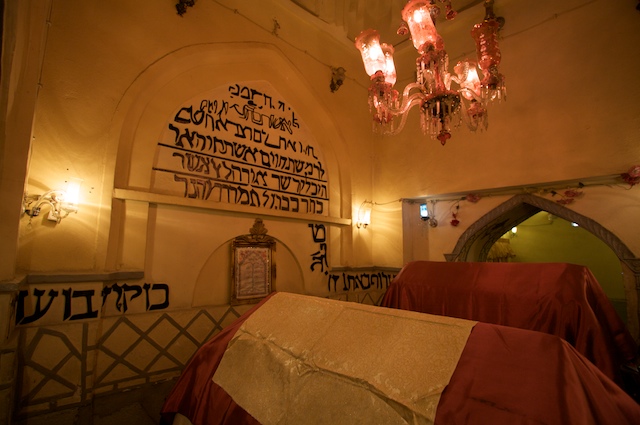
The entrance to the building is said to have been built intentionally low, in order to compel visitors to bow their heads upon entering, thereby engendering a requisite attitude of respect. Inside the main hall, which is adorned with Hebrew inscriptions, lie two large, decorated wooden boxes, or trunks, below which are said to be the final resting places of Mordechai and Esther.

A small synagogue adjoins the tomb, and the site is also considered holy by Muslims and Christians, who come to pray there as well.

Next to the mausoleum lies a large hollow in the ground, which Iranian Jews believe to be an entrance to a tunnel that stretches all the way to Jerusalem.


See picture here inside:

https://upload.wikimedia.org/wikipedia/commons/e/ee/Tomb_of_Ester_and_Mordechai_interior.jpg

The article entitled, "Who is Buried in Queen Esther's Tomb?" states:

"While various monuments in Persia have been cited as their burial place, a strong alternate tradition indicates that even though both Esther and Mordechai died in the Persian capital city of Shushan, they were brought to Eretz Israel for burial. Written tradition from the Middle Ages locates the burial place in the Galilean village of Bar'am, along Israel's northern border with Lebanon."


Apparently, this written tradition began with the account of HaRav Shmuel ben Shimshon who visited the site Bar'am in 1211. In 1537, the sefer Yichus Ho'ovos Vehanivi'im recorded, that "every Shushan Purim a minyan goes to her grave [in Bar'am] from Tsefas and reads the Megillah there."

The article later notes that knowledge of the exact location of the kevarim was lost over the centuries. The site identified today as the kevarim of Mordechai and Esther is located "more than a kilometer southwest of the ruins of ancient Bar'am".
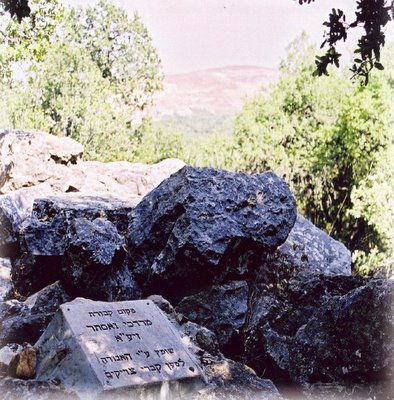

As early as 1215, Rabbi Menachem Ha-Hevroni wrote that while visiting the Galilee, he came across the tomb of Queen Esther, "who, during her lifetime, had instructed her son Cyrus to bring her there [for burial]". Later pilgrims mentioned the site, and noted that special celebrations were held there on Shushan Purim. Currently, the tomb is believed to be located in the ruins of a building found in the Baram National Park.

Why is this hidden?  Maybe it does not matter where they are buried? Or perhaps Queen Esther wanted it this way to teach us a new lesson or continue to teach us new and hidden messages? Even while I can not say with any certainty which of the two locations is more authentic or correct, of one thing we can all be sure: the deeds of these two great Jewish people will never fade from our collective memory. As the Megillah (9:28) itself tells us: "and these days of Purim shall not pass from among the Jews, and their memory shall not elapse from among their descendants".


Tuesday, November 27, 2012

Daddy Come Home

For all who have served , who are military brats or are now serving in either America or Israel. For all those Daddy's who did not come home too PLEASE  Hashem Please Bring ALL the Daddys Home to their Families and bring Peace with Moshiach Now!!!!

Enjoy this touching video.
For all of those who served/serving our country and those who are guarding the holy land of Israel!

http://www.youtube.com/watch?feature=player_embedded&v=xF7UVW6PLig


Shalu Shalom Yerushalyim!
"שאלו שלום ירושלים"
Psalms 122:6

Thursday, November 8, 2012

Raising Jewish Kids.

I do not raise my children to be Jewish, I raise my Jewish children.
Amazing how confused Jewish parents are about that when it comes to their children.
One local Jewish community member says to me "I'm raising my children Jewish" and I said "Huh! I'm raising Jewish children" and she turns to me and says "WOW! That is a good point!"

No Jewish parent should ever allow any community to raise their...

Jewish children and tell them they have to be Jewish when somehow all those precious Jewish children were not born Jewish enough. WHAT?! Amazing how Jewish Parents do not understand they are raising Jewish children in their Jewish homes with their Jewish values. It all starts in the home first. Jewish Community is in the home first. Your home sets the pace for your child on if they will be Shomer Shabbos and keep Jewish values of Torah and Mitvos and someday marry someone Jewish.

Then She asks me "What about Jewish Education are they not helping parents to raise their kids to be more Jewish?"
And I said to her, "Jewish education institutions is fine as long as you understand those institutions are educating Jewish children with their Jewish values, and not educationg your children to be Jewish". She says, "I guess I need to rethink my thinker".

Make the changes you need to to give your Jewish children the Jewish community (your home) where they can be themselves as Jewish children first. Being in outside Jewish community and getting a Jewish School Education is just refining the values they should already have. Parents you have the power is in you to guide the precious Jewish childrenyou have been given to stay Jewish. After all isn't that really what you are concerned about?

Monday, August 20, 2012

Sunday, January 8, 2012

Giving rude religious Jews the boot!

I was at a show recently and I was just absolutely shocked by seeing a beautiful and exceptionally polite Chabad Rebbetzen walking around in platform skinny heel boots that went to her knees. It look like someone took a very long carpenter's nail and nailed it on the bottom of her boot and called it a heel. Platform skinny heel boots conger's up scenes in a urban movie of a lady of the night with alot of violence drugs and alcohol. I do not watch movies like that, but have seen plenty ads for such movies like that. I shook my head in shock and I was thinking "wow things have changed among our Chabad women's dress code of Tzniut".  It was not the first time that I have seen the dress styles among religious frum women that were boardering and almost breaking Tzniut Jewish halacha.
http://youtu.be/F_pfFuDkj0Q

Then the Beit Shemesh Chereidim attacks a little girl that is the grand daughter of dear friends in Israel. A Modest religious family is attacked by the Chereidim for what they claim she a 7 year old for being immodest! what? What is going on here? Then a Chereidi little girl gets attacked in Beit Shemesh too? What is this?Many think of Judaism as a single religion, but it has as many denominations and subsets as Christianity does. Orthodox Judaism equally breaks down into countless subsets. Most of the problems in Jerusalem concern 19th century immigrant sects which never reconciled themselves to the creation of the State of Israel, and have in some cases made common cause with Islam. That being said it is a complicated issue. I do not think there needs to be one way of expressing Judaism in observence. The common thread should be that we all are Torah observant to the best of our understandings and family traditions and no I'm not talking about secularism either.

What do I mean by this? Shulchan aruch שׁוּלחָן עָרוּך‎, literally: "Set Table" which most would immediately think "Code of Jewish Law" right? Yes of course, but let's simplify this a bit to understand where I'm coming from. Every household has a way of abserving Jewish law (Shulchan Aruch) by the way their families for generations have done things and not to mentione in the siddur prayers alone there so many tunes to these prayers which most if not all these tunes are due to weather the family is Sephardic or Ashkenazic or the fact the family has lived in Spain, Turkey, Iran Iraq and even the United States. Not to mention which Posek Rabbi one's family may follow. This is where all the different subsets of Judaism formed. So in essence every Jewish family have traditions that can reflect how they observe and dress Tzniut according to how they "set their Observence of Torah tables". Not literally setting their tables, but setting traditions according to their families generations of traditions. This means that people do set their level of observence to their understandings and is influenced by their family traditions. I have personally have seen differences among Chereidim in traditions from one shabbos table to another or one shul to another and yes even in the dress code of in Tzniut in Chereidt women depending on the neighborhood or block or street they live on. I have seen some frun women pushing of the envelope so close in breaking Tzniut that boarders one to question what is she thinking? I have see this among almost every facet of religious subset  groups by simply living in Israel and having family that are of many different subsets of Judaism living there too. Like for example there is difference in the way Jews from the southern part of the United States vs. a Jew from the southwest, mid west or even the north west or the northeast part of the United states do things. Their Traditions of Torah observence are all different from one another.

The fact that everyone of these Jews can pray together is amazing because they may have different tunes for any one prayer from the siddur, but each Jew  can adapt and read the prayers together and honor one another with respect to each other's differences. It is amazing when you wittness that in action.  I have seen this first hand in Chabad and I have been blessed to wittness this even with Rabbi Shlomo Carlebach zt'l of Blessed Memory. The Renewel movement seems to get the point also of just respecting every Jew and be accepting and loving and kindness to one another. The Lubatcher Rebbe OBM says that "Every Jew is a Diamond". So I ask why are we breaking precious Diamonds into a million pieces by acting like this towards one another? That is just creating more divisions among us. As for the Rebbetzen and her boots well she was dressed modest and no skin was showing, not her knees,  not her calfs,  not her arms, nor her neck etc. It's her choice to wear boots like that and she was not breaking any modesty code of Tzniut within Chabad simply because she was covered from head to toe and I do know she would not wear them if that were breaking halacha. I cannot be the one to tell her how to set her table of observence either. Even though I want to give those Chereidim the boot out of Beit Shemesh that spit on my friend's grand daughter or give the boot to the modern orthodox that attacked the Chereidi girl. The best we can do is pray for tshuva for those who are unkind and causing harm to other. We cannot radiate light to the nations if we continue to stomp out the lights amongst us. So yall Knock it off . Love and peace to us all!! Kol Hakavod!

Wednesday, November 30, 2011

Generation of Exodus

The great Kabbalist Rabbi Isaac Luria writes that the last generation before the coming of Moshiach is the reincarnation of the generation of the Exodus.  In my last blog post I wrote about my daughter's spiritual journey towards her Bat Mitzvah. Well I read a intersting thought today that sparked a new understanding for me personally.

"Today, as we stand at the threshold of the ultimate redemption, it is once again the woman whose song is the most poignant, whose tambourine is the most hopeful, whose dance is the most joyous. Today, as then, the redemption will be realized in the merit of righteous women. Today, as then, the woman’s yearning for Moshiach — a yearning which runs deeper than that of the man, and inspires and uplifts it — forms the dominant strain in the melody of redemption."
Based on the teachings of the Lubavitcher Rebbe

 
(C)Copyright 2006 silk painitng by Rivka Sari

There is no doubt as a religious woman I yearn for Moshiach so much more than I ever have. The world seems to be in caos and so much is terrible happening around the world that I 'm concerned for the future of my children and their future generations. Is there going to be a world left? So when I read this teaching from the Rebbe I realized this is getting to be the generation of redemption. I'm now begining to understand that my daughter is feeling it too. Is she that generation? I do not know the answer, but one thing I do know that the golus (Exile) is coming to a end because knowledge is increasing at such a rate that only goodness will be desired. We are are certainly headed for a better world to come, the Olam Haba. As we are getting ready to celebrate Chanukah we are celebrating light and it will multiply as time moves forward.  See you in Jerusalem! 

 "קץ ישטטו רבים ותרבה הדעת"

Tuesday, November 22, 2011

Bat Yisrael (Daughter of Israel)

As I watch my daughter study Torah in Jewish school I began to realize she is just four years from bat mitzvah and it struck me we have to start planning now. But then I breathed a sigh because I have been planning this since she was born. The only real tangible thing we can give our children is Torah because it is the only one thing that shows her how to be a good Jew and be a good fellow human being. I want her to live a good spiritual life and pass on Torah to her children. I read Psalms 128 and I realized this blessing is not just for a man but one that is for a woman. Women have the most influence on children and I pray I have been doing ok in that department.

שיר המעלות אשרי כל־ירא יהוה ההלך בדרכיו׃
יגיע כפיך כי תאכל אשריך וטוב לך׃
אשתך כגפן פריה בירכתי ביתך בניך כשתלי
זיתים סביב לשלחנך׃
הנה כי־כן יברך גבר ירא יהוה׃
יברכך יהוה מציון וראה בטוב ירושלם כל ימי
חייך׃
וראה־בנים לבניך שלום על־ישראל׃
Psalms 128


Women don't have to be like men, and men don't have to be like women, every single creation has a purpose in this world, a purpose which no one else but him or her can accomplish. Being religious jewish family I am told that a woman does not need the spiritual elevation of milah, or a kippah for that matter. Nor does she need an aliyah to the Torah. The word "aliyah" means to be called up, be elevated; a woman does not need the public elevation which comes from being called up to the Torah. This is because she is either naturally elevated due to her unique spiritually sensitive feminine soul, or because she achieves elevation through observing those special mitzvot which are designed to elevate the Jewish woman. But my daughter wants to go up to Torah not because she wants to be like a man or to prove she can do anything like a man can.

 My daughter says she wants to have her special moment singing her "Song of Miriam". She explains it like this. When Moshiach arrives we will sing the song of Moshe and Miriam. And that song is our portion of the Torah that is troped based on the date of our birth. Wow talk about spiritual at age 7 1/2 already! She describes that the Song of Moshe and Miriam in the olam haba (world to come) is it will start with Jewish people who were born during weekly parsha reading of Bereshes will sing and then the next parsha to the next until the whole Torah is sung. Powerful scene right? Needless to say I was speechless by her dream and vision also by her strong desire to learn her portion's trope (Hebrew cantillation) so she can indeed make alyia at her bat mitzvah. I have lately been exploring options where she can be frum still and have her alyia to to read the Sefer Torah. "Women of the Wall" maybe that option or "Feminist Orthodox Movement" maybe another option.
The chassidic masters teach "The tenth song, says the Midrash, will be the shir chadash, the "New Song" of the ultimate redemption: a redemption that is global and absolute; a redemption that will annihilate all suffering, ignorance, jealousy, and hate from the face of the earth; a redemption of such proportions that the yearning it evokes, and the joy it brings, require a new song -- a completely new musical vocabulary -- to capture the voice of Creation's ultimate striving."
see (http://www.chabad.org/parshah/article_cdo/aid/2744/jewish/Miriams-Song.htm) My daughter says "this the singing of the whole Torah in the Olam Haba." My daughter is definately touching on a huge spiritual concept at such a young age.

Whatever choice we find to make my daughter's dream a reality, we know that she will make every step towards her bat mitzvah a wonderful journey. My daughter wants to go beyond the party and reading a poem or even having a speach she says I want to sing that song that Hashem gave every Jewish Neshama born into this world. Then she really sends my mind on a high beyond high and says she has to have to have that practice time for the olam haba (the world to come). So we have four years to prepare and if Moshiach arrive then she will be ready if not then B"H she will have her time to practice. Either way I already know she is taking Torah and will pass it on to her children. L'dor V'dor! (generation to generation)

May you live to see your world fulfilled.
May your destiny be for worlds to come;
May you trust in generations past and yet to be.
My your heart be filled with intuition and words with insight;
May songs of praise ever be on your tongue
And your visions be on a straight path before you.
From the Talmud~